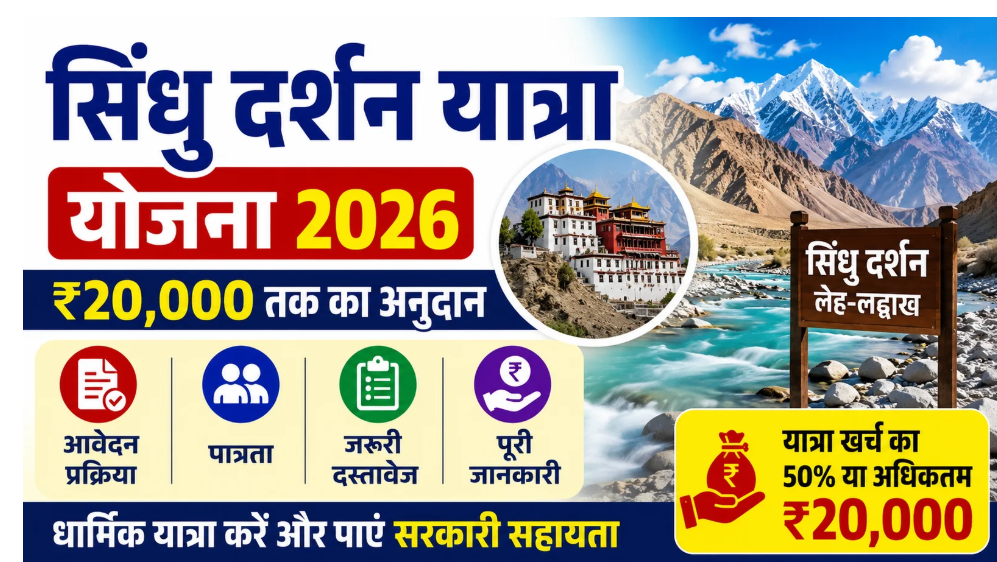
The Sindhu Darshan Yatra holds a unique place among India’s pilgrimage traditions — a journey to the banks of the sacred Sindhu (Indus) River in Leh, Ladakh, that symbolizes national unity and cultural heritage. To make this once-in-a-lifetime journey more affordable, several Indian state governments run their own Sindhu Darshan Yatra financial assistance schemes, reimbursing pilgrims a portion of their travel costs. With Bihar becoming the latest state to approve such a scheme in 2026, interest in these programs has surged. This article breaks down everything you need to know — eligibility, application process, required documents, and benefit amounts — across the states currently offering this support.
What Is the Sindhu Darshan Yatra?
Before diving into the scheme details, it helps to understand the pilgrimage itself. The Sindhu Darshan Yatra began in 1997, conceived by L.K. Advani and journalist Tarun Vijay, as a way to celebrate the Sindhu River — the river from which India derives its name (Sindhu → Hindu → Hindustan). The festival began its first year in October 1997, and each successive celebration occurs annually in June to mark the occasion of Guru Purnima. Devotees gather near the banks of the Indus River at Shey, about 8 km from Leh, where pilgrims bring water from rivers across India to pour into the Sindhu as a symbol of unity in diversity.
In 2026, the Yatra holds special significance — it marks the historic 30th Sindhu Darshan Yatra, also recognized as the Pratham Sindhu Kumbh, scheduled for June 23–27, 2026.
Because the journey to Leh-Ladakh involves significant travel, accommodation, and altitude-related logistics, several state governments have introduced subsidy schemes to encourage their residents — particularly middle-class families — to undertake this pilgrimage.
Important Clarification: There Is No Single Central “Sindhu Darshan Yatra Scheme”
A common point of confusion is that people search for “the” Sindhu Darshan Yatra Scheme, expecting one nationwide programme. In reality, each state runs its own independent scheme, with its own eligibility rules, benefit amount, and application process. The common thread across all of them: financial reimbursement to residents who complete the Sindhu Darshan Yatra and submit proof of having done so.
States currently known to operate such schemes include Haryana, Gujarat, Rajasthan, Bihar, Uttar Pradesh, Chhattisgarh, and Madhya Pradesh, with Bihar being the newest to join this network of state-level pilgrimage subsidy programs in 2026.
2026 Update: Bihar’s New Sindhu Darshan Teerth Yatra Financial Assistance Scheme
The biggest development this year comes from Bihar. The Bihar government approved the Sindhu Darshan Teerth Yatra Financial Assistance Scheme 2026 during a state Cabinet meeting, aimed at supporting residents undertaking the pilgrimage to the sacred Sindhu River in Ladakh.
Key features of the Bihar scheme:
- The government will reimburse 50% of the travel cost or a maximum of Rs 20,000 per person, whichever is lower.
- The scheme is intended to make pilgrimage tourism accessible to middle-class families who previously could not afford a trip to Ladakh.
- The scheme was cleared following a recommendation from the state’s Tourism Department.
As this scheme was only just approved, the detailed application portal and document checklist for Bihar residents are expected to be notified soon by the state Tourism Department. Interested applicants should keep checking official Bihar government tourism channels for the formal notification.
State-wise Comparison of Sindhu Darshan Yatra Schemes
| State | Financial Assistance | Beneficiary Cap | Application Window |
|---|---|---|---|
| Bihar (2026) | 50% of travel cost or max Rs 20,000, whichever is lower | Not yet specified | To be notified |
| Gujarat | One-time grant of Rs 15,000 per pilgrim | Maximum 300 pilgrims per financial year | Within 60 days of completing the yatra |
| Rajasthan | 50% reimbursement or maximum Rs 10,000, whichever is lower | Maximum 200 pilgrims; lottery system if applications exceed the cap | Within two months of completing the journey |
| Haryana | Up to Rs 10,000 or 50% of actual expenditure, whichever is lower | Maximum of 50 pilgrims | Within two months after the Yatra |
Note: Figures and caps are subject to periodic revision by respective state governments. Always verify current limits on the official portal before applying.
Eligibility Criteria
While exact conditions vary by state, the general eligibility pattern across all these schemes includes:
- The applicant must be a permanent resident/domicile of the state offering the scheme (e.g., a permanent resident of Haryana, a native of Gujarat, or a domiciled resident of Rajasthan).
- The pilgrim must have actually completed the Sindhu Darshan Yatra — assistance is reimbursed after the journey, not before.
- In Rajasthan, the minimum age for applicants is 21 years.
- The journey must be undertaken through a recognised organiser, and a Yatra Completion Certificate from the Sindhu Darshan Yatra Samiti or relevant authority is mandatory.
- The benefit can typically be availed only once in a lifetime per pilgrim — most states explicitly state the grant is available once in a lifetime per pilgrim.
- Some states disqualify applicants in specific categories, such as those earning a livelihood through begging.
- The application must be submitted within a fixed window after completing the yatra — this ranges from 60 days in Gujarat to two months in Haryana and Rajasthan.
How to Apply: Step-by-Step Process
Most states follow a broadly similar offline/online process. Here’s the general roadmap:
Step 1: Complete the Yatra First
Since this is a reimbursement scheme, you must complete your Sindhu Darshan Yatra travel before applying. Keep all your travel tickets, hotel bills, and receipts safely — you’ll need them as proof of expenditure.
Step 2: Obtain a Yatra Completion Certificate
A Yatra Completion Certificate issued by the Sindhu Darshan Yatra Samiti, Delhi (or the relevant state/central authority/recognised society) is required as core proof that you actually undertook the pilgrimage.
Step 3: Fill Out the Application Form
- Online route: Applications can be submitted online via portals such as the Antyodaya-SARAL Portal (Haryana), or the equivalent state-specific portal (e.g., Gujarat’s yatradham.gujarat.gov.in, or Rajasthan’s Devasthan Department portal).
- Offline route: Take a printout of the prescribed application format, fill in all mandatory fields including details of pilgrims and the authorized travel agent/organizer, and attach self-attested copies of required documents.
Step 4: Submit to the Designated Authority
Depending on the state, this could be:
- The Director of the Tourism Department (Haryana)
- The Gujarat Holy Pilgrimage Development Board, Old Secretariat, Gandhinagar (Gujarat)
- The Devasthan Department (Rajasthan)
- The state Tourism Department office (Bihar, once the notification is released)
Step 5: Verification and Approval
The reviewing authority verifies the documents and forwards the application for approval within a set timeframe (around 15 days in Haryana).
Step 6: Disbursement
Once approved, the financial assistance is released — in some states via Demand Draft, while in others it is directly credited to the beneficiary’s bank account through DBT (Direct Benefit Transfer).
Documents Required
Across most state schemes, you will typically need:
- Identity proof (Aadhaar card or equivalent)
- Address proof / domicile certificate of the respective state
- Passport-size photographs
- Yatra Completion Certificate from the State/Central Government or recognised Society
- Travel tickets (bus/rail/air) and accommodation bills as proof of expenditure
- Bank account details (for DBT-based disbursement)
- A self-declaration that you have never claimed this financial assistance earlier and will not claim it again in the future
- A medical fitness certificate, in states where this is required given the high-altitude nature of the journey
Why These Schemes Matter
Travelling to sacred and remote destinations can be financially demanding for ordinary pilgrims, and these schemes are designed to ease that burden while encouraging people to engage more deeply with their cultural heritage. Leh-Ladakh’s remoteness, high-altitude logistics, and seasonal accessibility (the Yatra window is narrow — usually just a few days around Guru Purnima in June) mean travel costs can be substantial for a family. Reactions to Bihar’s 2026 announcement reflect this sentiment — with many calling it a welcome move for middle-class families who always wanted to visit Ladakh but previously could not afford it.
Frequently Asked Questions (FAQs)
1. Is there one common application portal for all states? No. Each state operates its own portal and process — Haryana uses the Antyodaya-SARAL Portal, Gujarat uses its dedicated Yatradham portal, and other states have their own departmental procedures.
2. Can I apply before going on the Yatra? No. These are reimbursement schemes — you must complete the Yatra first and then apply with proof of completion within the specified window.
3. Can I claim the benefit more than once? No. The benefit is available only once in a lifetime per pilgrim across all known state schemes.
4. What happens if more applications come in than the beneficiary cap? In states like Rajasthan, if applications exceed the annual cap, selection is done through an online lottery system.
5. Has Bihar released the official application form yet? As of this writing, Bihar’s Cabinet has approved the scheme, but the detailed application process and portal are expected to be notified separately by the state Tourism Department. Aspiring applicants should monitor official Bihar government channels for updates.
Conclusion
The Sindhu Darshan Yatra Scheme — in its various state-specific forms — reflects a growing trend of Indian state governments supporting religious and cultural tourism through direct financial assistance. With Bihar’s 2026 scheme joining the ranks of Haryana, Gujarat, and Rajasthan, more pilgrims than ever now have a pathway to experience this historic 30th-anniversary Yatra without the full financial burden falling on their shoulders. If you’re planning to undertake the Sindhu Darshan Yatra this year, check your home state’s tourism department website for the latest eligibility rules, application deadlines, and required documentation before you travel — that way, you can plan your reimbursement claim right from the start of your journey.